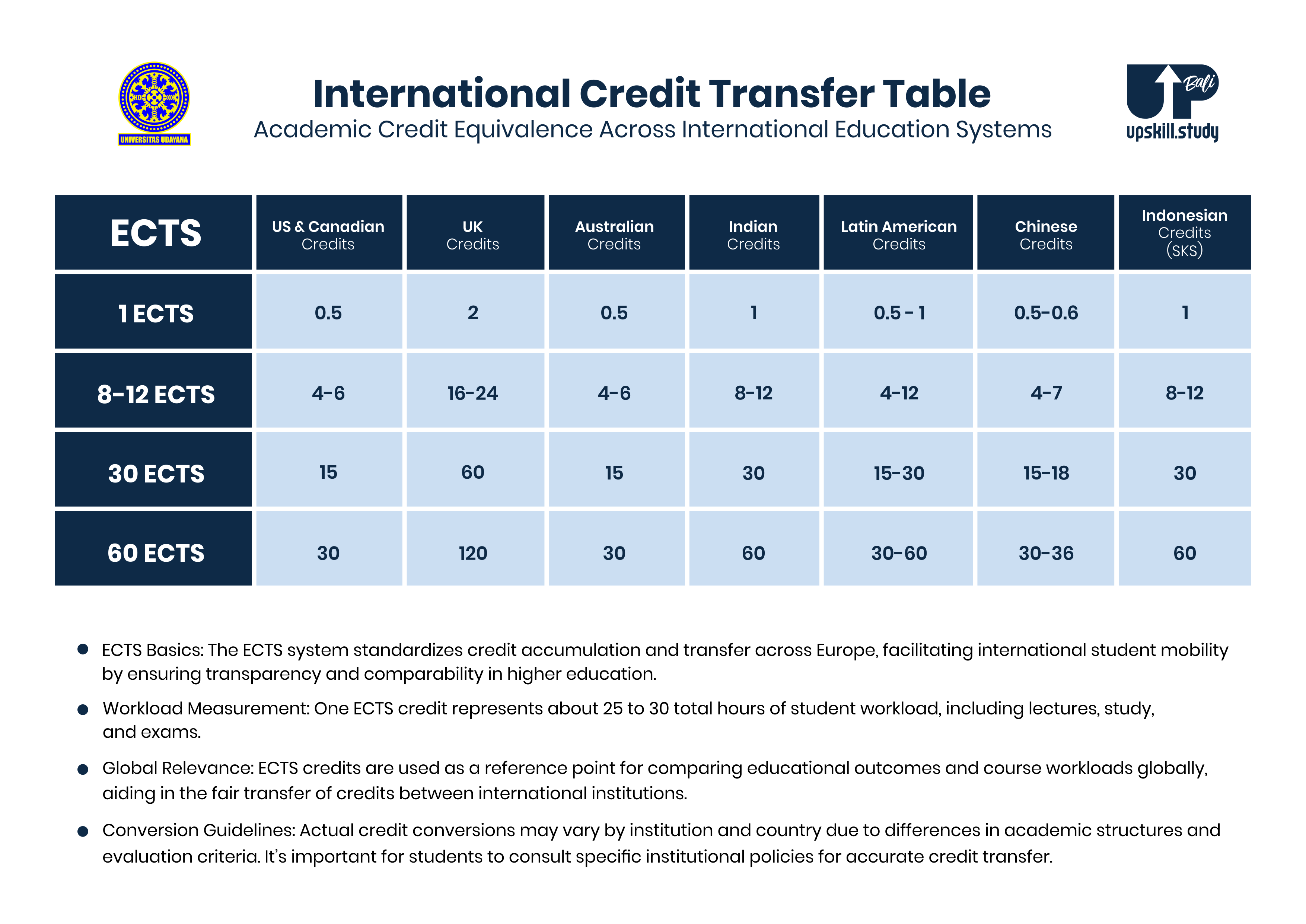
Indonesian Academic Credit Conversion Information
This page provides a clear reference for understanding the Indonesian higher education credit system and how academic workload is calculated and assessed for international credit recognition. It is intended to support partner universities, agents, and students in evaluating academic equivalency, workload expectations, and semester alignment.
The Indonesian academic credit system is a nationally regulated framework based on clearly defined workload expectations and academic standards. When assessed through documented workload hours and academic level, semester-based programs in Indonesia are directly comparable to full-time bachelor and master-level study in international higher education systems.
Overview of the Indonesian Credit System
Indonesian public universities operate under a nationally regulated academic credit framework known as SKS (Satuan Kredit Semester). This system is governed by the Indonesian Ministry of Education and is applied consistently across state and accredited private universities.
Credits in Indonesia are defined primarily by student workload, rather than by the use of international credit labels. For this reason, international credit recognition is assessed through documented workload hours, academic level, learning outcomes, and assessment structure.
One local credit unit (1 SKS) represents approximately 45 to 50 total student workload hours over the duration of a semester.
This workload includes a combination of:
Scheduled teaching activities, such as lectures, seminars, tutorials, and supervised academic sessions
Structured academic activities, including guided assignments, group work, presentations, and preparation directly linked to the course
Independent self study, including required readings, research, reflection, and preparation for assessments
Across a standard semester of 14 to 16 weeks, this workload distribution reflects nationally defined expectations for higher education in Indonesia.
Semester Structure and Full-Time Study Load
A full-time academic semester in Indonesia is structured to represent a complete and balanced workload comparable to full-time study in other higher education systems.
A full semester typically corresponds to a total workload of approximately 750 to 900 student work hours, based on:
A 15 to 16 week teaching period
A 37 to 40 hour academic work week, including both contact hours and independent study
This total workload benchmark is commonly used by international universities when assessing whether an external program is equivalent to a full semester of study.
International Credit Recognition and Conversion
Assessment methods may include a combination of:
Written assignments and essays
Group projects or applied case studies
Presentations and reflective reports
Research-based tasks or final examinations
Each module is assessed independently, allowing clear documentation of learning outcomes, grading, and academic performance for credit evaluation purposes. While some international institutions may internally calculate equivalencies using systems such as ECTS, others typically assess external programs based on:
Total documented workload hours
Academic level and rigor
Structure of teaching and assessment
Coherence and completeness of the semester
For this reason, official documentation focuses on workload, level, and academic content, rather than on the use of specific international credit labels.
Where required, equivalency calculations can be provided as a reference comparison, but the primary basis for recognition remains workload and academic structure.
Documentation Provided
For credit evaluation and recognition purposes, the following documentation can be made available:
Official acceptance or enrollment letter issued by the host university
Detailed course and module descriptions, including learning outcomes, workload, and assessments
Academic calendar and semester structure
Proof of tuition payment where required
Official academic transcript upon completion
These documents are designed to support home universities in making informed and transparent credit recognition decisions.